 for Business
Tubes are used to reduce the bounce so that the ball does not bounce too much even on hard ground.
Coated surface for improved control and durability with sand prevention valve
MAGNAS
The standard match ball, the "thermal ball"
Most of the balls used as match balls in official soccer matches are made using a method called thermal manufacturing, in which panels are pressed together using heat.
The panels are attached directly to the tubes inside the ball without using any thread, so the gap-free joints prevent water from entering and there is no need to worry about the ball becoming heavy even in the rain.
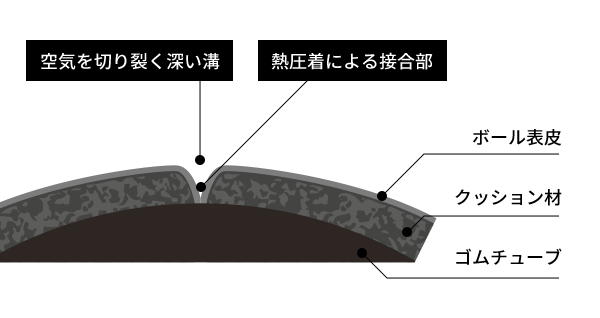

Furthermore, pressure is applied evenly to bond the panel boundaries, resulting in high sphericity, allowing you to kick the ball with the same feeling no matter where you kick it.

The thermal ball revolutionized the world of soccer in the 21st century with its stable kicking feel and flight properties, and is loved as the match ball for official matches around the world.
A new standard practice and match ball for schools and teams across the country
SFIDA, which has its roots in the manufacture of high-quality, hand-sewn fair trade soccer balls, is challenging the price of thermal balls.
I want to use balls of the same quality as the official balls even during practice!
To support soccer club members and coaches across the country who continue to challenge themselves to achieve their dreams and goals, MAGNAS has achieved the quality of an official match ball at the price range of a practice ball.
Please choose the best ball depending on the environment in which you will be using it.
Hard Ground
TURF GROUND
The tube is bouncy enough to ensure a good bounce even on soft grass.
Embossed for optimal slip resistance and delicate ball touch
Embossed for optimal slip resistance and delicate ball touch
The rubber used for the tubes is made with a high proportion of butyl rubber, which has low air permeability, to minimize natural air leakage.
SPEC

The name "MAGNAS" comes from the Magnus effect, which describes aerodynamic characteristics.

Sfida's advanced thermal manufacturing process, "heat bonding," uses patented special panel molding technology to produce more uniform, high-quality balls. This allows for deeper grooves in the ball's panels, resulting in superior aerodynamic properties and flight stability.
What is the Magnus effect? = A perpendicular force acting on a rotating object
The grooves (dimples) between the solid panels of MAGNAS amplify this Magnus effect, extending the lift and deflection of the spinning ball and preventing it from slowing down, providing the ball with high-performance distance, flight stability, and control.


LINEUP

Control valve for soil sand prevention / Surface coating for improved durability
JFA Certified Soccer Ball, Size 5, 32 Panel Thermal
MAGNAS Earthly Life
¥ 5,390


Embossed for a delicate touch on grass
JFA Certified Soccer Ball, Size 5, 32 Panel Thermal
MAGNAS for turf
¥ 5,720


Control valve for soil sand prevention / Surface coating for improved durability
JFA Certified Soccer Ball, Size 4, 32 Panel Thermal
MAGNAS Earthly Life
¥ 5,280


PHOTO GALLERY


